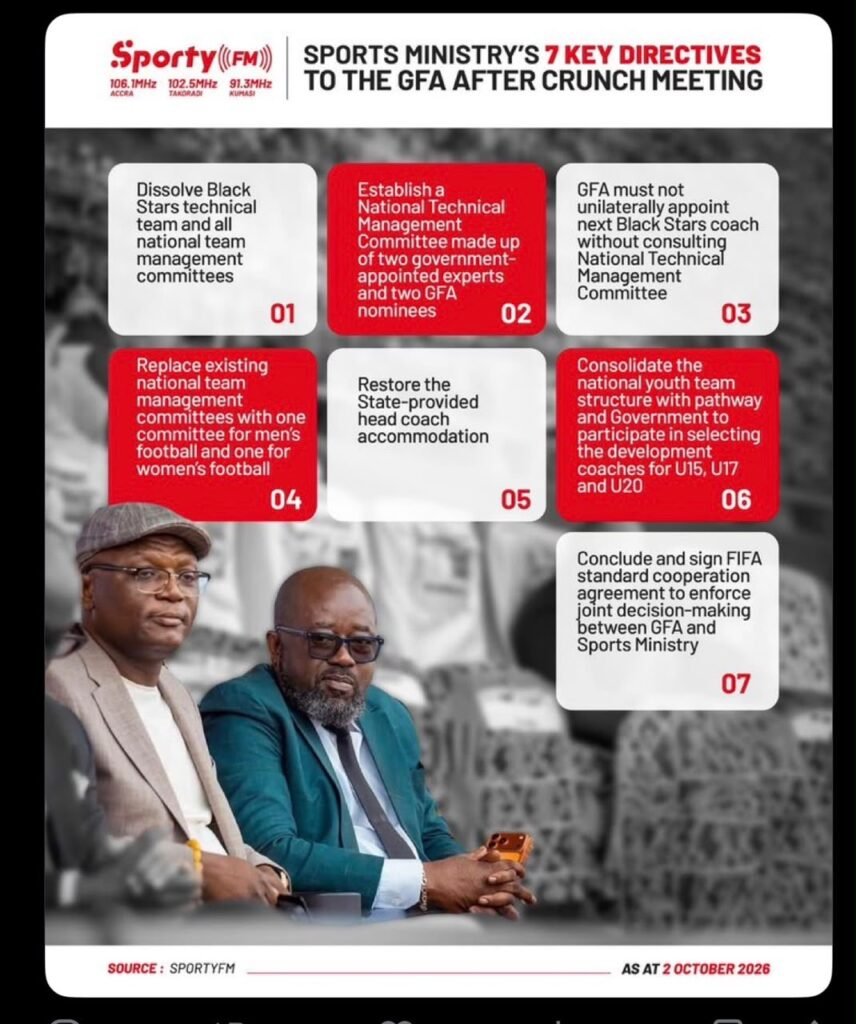
Ghana’s Ministry of Sports and Recreation has set out seven proposed changes for the management of the country’s national teams after a high-level meeting with the Ghana Football Association. The measures go beyond the search for a new Black Stars coach: they also address technical oversight, national-team committees, youth development and the formal relationship between the ministry and the GFA.
The directives were reported by Sporty FM and carried by GhanaSoccernet and other Ghanaian outlets after the October 2 meeting. They should be understood as proposed administrative measures whose implementation will depend on further engagement between the ministry and the football association.
What the seven directives cover
The first major proposal is the dissolution of the existing Black Stars technical team and the national-team management committees. In their place, the ministry wants a National Technical Management Committee made up of two government-appointed experts and two nominees from the GFA.
The proposed committee would have a role in technical decisions affecting the national teams. The ministry has also directed that the GFA should consult the committee before appointing the next Black Stars head coach. That point is especially important because Ghana is already conducting a separate search for a successor to Carlos Queiroz.
The existing national-team management structure would also be replaced by two broader committees: one for men’s football and another for women’s football. The stated aim is to create a more coordinated structure instead of maintaining separate arrangements without a clear relationship between them.
Another proposal concerns the living arrangements of the Black Stars head coach. The ministry wants state-provided accommodation for the coach restored. It has also called for Ghana’s youth national teams to operate within a clearer development pathway, with government participating in the selection of development coaches for the under-15, under-17 and under-20 teams.
The seventh measure is a FIFA-standard cooperation agreement between the ministry and the GFA. Such an agreement would give the two institutions a formal framework for joint decision-making rather than leaving responsibilities to informal meetings or public statements.
Why the timing matters
The proposals follow Ghana’s difficult opening to the 2027 Africa Cup of Nations qualifying campaign. Reports on the meeting said the Black Stars lost 2–0 to Côte d’Ivoire in Bouaké before a 4–2 defeat to The Gambia in Accra, after Ghana had taken a two-goal lead. Those results created immediate pressure around the coaching position and the wider administration of the national teams.
The context matters because the directives are not simply a reaction to one result. They seek to change who participates in technical decisions, how youth teams are connected and how the government and the football association work together. That makes the proposed cooperation agreement and the composition of the new committee as important as the individual coaching appointment.
What remains unresolved
The public reports do not establish that every directive has already been implemented. They also do not identify the four people who would serve on the proposed National Technical Management Committee. Until the ministry or GFA publishes the formal terms, the responsibilities of that body and its relationship with existing GFA structures should be treated as outstanding questions.
The same caution applies to the next coach. The ministry’s proposal may affect the appointment process, but it does not name a candidate or confirm a final shortlist. Ghana’s search committee remains a separate development, and supporters should distinguish a proposed consultation framework from a completed appointment.
The next useful update should therefore come from the ministry or the GFA. Readers need to know whether the directives have been accepted, which ones will take effect first, who will sit on the technical committee and how the FIFA-standard cooperation agreement will be drafted. Until those details are published, the seven directives are best understood as a proposed governance reset rather than a completed restructuring.